Integrating Drawing with Mathematics: It Works!
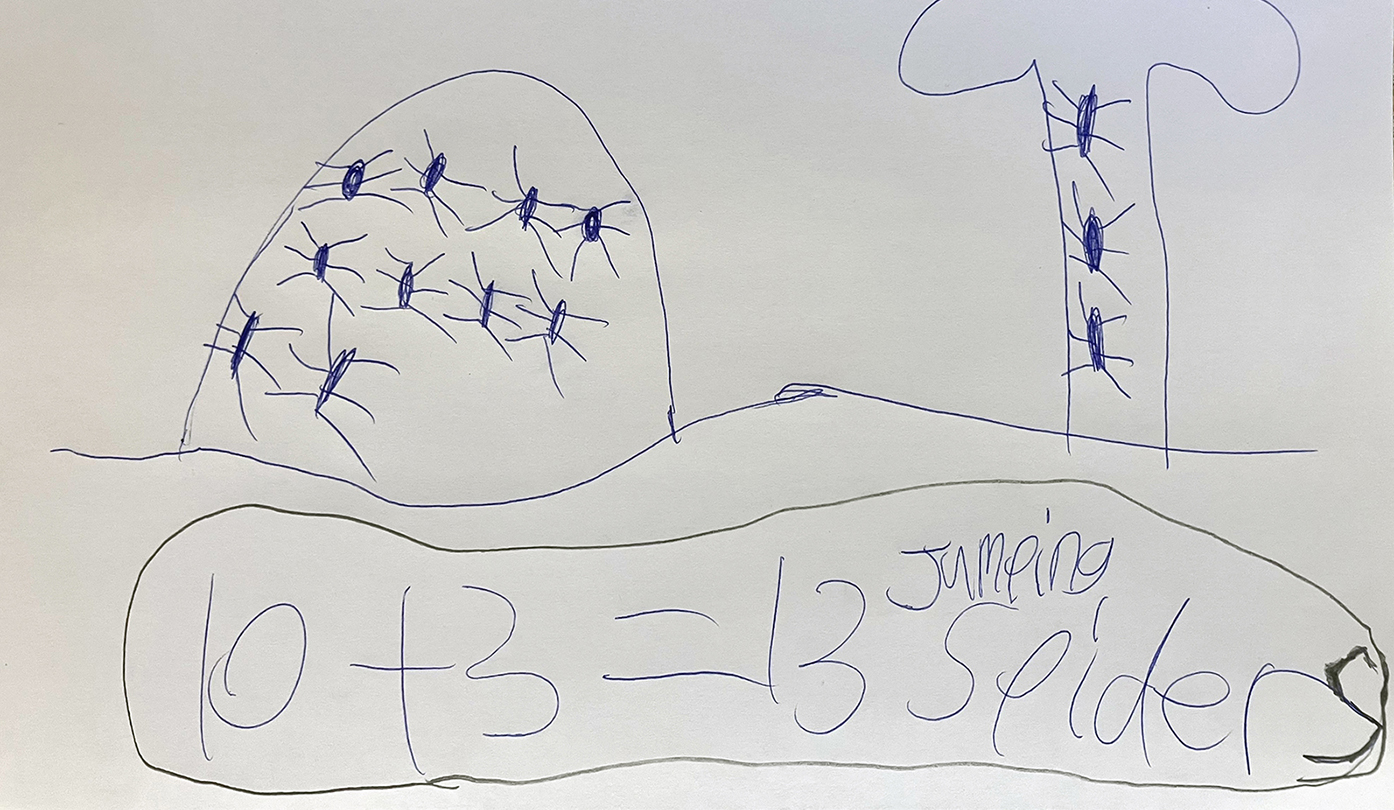
As a first-grade teacher, I know that one of the most difficult mathematical skills for young students to master is that of solving word problems. Often, they have difficulty understanding what the story is all about. Should they add or subtract? How can they solve it?
While word problems prove to be difficult for young children, they are also important because they mimic real life. In fact, researchers Gros et al. (2025) noted that:
“Word problem solving is a central component of mathematics education. Calculating how many eggs are needed to cook an omelet or how long it takes for a bathtub to fill up are typical exercises designed to help children learn how to use abstract mathematical notions in concrete, real-life situations.” (p. 76).
Vessonen et al. (2024) found when students struggle to solve word problems, it is not always due to lack of mathematics skills; they first need to understand what the word problem is describing and be able to extract information from the problem.
So, how can teachers help students with these difficult tasks? Why, the arts, of course.
For my research, I gave my students a pre-test, comprised of word problems. Then, we incorporated drawing into our word problem practice for the following eight days. The students drew about the stories to help them determine if they should add or subtract. Then, they drew to solve the problems.
After eight days of drawing and solving, the students took a post-test. Interestingly, none of the students used drawing on the pre-test to solve the problems. On the post-test, all of the students used drawings for most or all of the problems. The results of this test were encouraging. Seventy-three percent of the students had an increase in their scores from the pre-test to the post-test. The other 27 percent had scores that were the same – their beginning score was already showing proficiency. There were no students whose scores decreased.
Why was the strategy of drawing so effective? There is much research that has determined that integrating the arts has positive effects to students’ understanding of mathematics.
“This integration is further supported by research demonstrating that implementing Arts Integration can raise student achievement and engagement in students from both low and high socioeconomic backgrounds,” wrote Snyder et al. (2014, para 6).
Other researchers have found similar results to my small research study. Choutou and Potari (2024) wrote that teachers can help young students to link visual art and mathematics by integrating them in their teaching. Students can be explicitly taught to draw about what they are thinking when solving math problems.
Similarly, Lee and Hwang (2021) wrote that teachers often simply teach an algorithm, but teaching students to use schematic representations, such as simple drawings, can improve problem-solving abilities in word problems
In addition to the learning that took place, incorporating drawing into our math lessons was fun! Students were engaged every day. As soon as I said it was time for math, they immediately took their drawing papers out. They wanted to take their simple drawings home each day. They made connections from their drawings to real-life situations.
They enjoyed the learning, used creativity, and they mastered some difficult skills. They asked for more time to add details to their drawings after the problems were solved. We will continue to integrate drawing – and other artforms – into our math lessons.
Laura Giles is a lover of all things art, a first-grade teacher in Alpine School District, a writer for The Daily Herald newspaper, an Arts Leadership Academy graduate and has earned the Arts Integration Endorsement from Brigham Young University. She can be reached at LauraCGiles@gmail.com.
References
Choutou, Chrysoula & Potari, Despina (2024). Investigating boundaries and boundary crossing between mathematics and visual art teaching in a collaborative setting. Journal of Mathematical Behavior. https://doi.org/10.1016/j.jmathb.2024.101138
Gros, Hippolyte; Thibaut, Jean-Pierre; Emmanuel (2025). Uncovering the interplay between drawings, mental representation, and arithmetic problem-solving strategies in children and adults. Memory and Cognition. 53 (1). https://research.ebsco.com/c/25xrgu/viewer/html/okpazgf3f5
Lee, Ji-Eun & Hwang, Sunghwan (2021). Elementary students’ exploration of the structure of a word problem using representations. International Electronic Journal of Elementary Education. 14(3), 269-28. https://doi.org/ 0.26822/iejee.2022.243
Snyder, Lori; Klos, Patricia; Grey-Hawkins, Lauren (2014). Transforming teaching through arts integration. Journal for Learning Through the Arts. 10(1). https://doi.org/10.21977/D910119308
Vessonon, T; Dahlberg, M.; Hellstrand, H.; Widlund, A.; Korhonen, J.; Aunio, P.; Laine, A. (2024). Task characteristics associated with mathematical word problem-solving performance among elementary school-aged children: A systematic review and meta-analysis. Educational Psychology Review. 36 (4). https://doi.org/10.1007/s1064-024-09954-2


