The Invisible Biases: The Elephant in the Room
An Unexpected Lesson in Honoring Navajo Culture in the Classroom
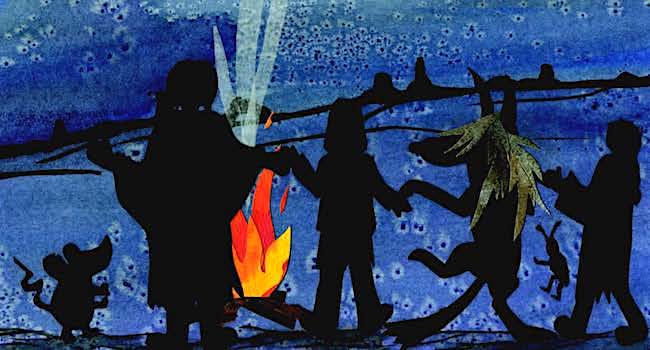
Last week, we had our first frost in Monument Valley, time to tell the enduring Coyote stories. I was seated in the back of my classroom, listening to a highly respected elder in our Navajo Nation. He was sharing Diné oral stories, honoring the traditions of their ancestors. Being a guest in this sacred land, I believe it is my responsibility as an educator to embed my students’ culture in our Art and Technology classes. As he shared the compelling stories of the trickster or troublemaker coyote—each of my students' marveled at hearing about the mischievous creature and the moral lessons to be gained from each story. The elder started singing their people's sacred songs while beating on the student’s desk in front of him. He paused in reverence. I raised my hand and asked about the chants. One of my 12th graders sitting next to me, placing her hand gently on mine with a smile on her face said, “Mrs. Johnson, they are not chants; they are songs.” I felt embarrassed and clasped her hand in mine, “I’m sorry. Thank you for correcting me. They are beautiful songs.”
For the last three years, I have taught at Monument Valley High School in Utah, in the heart of the Navajo Nation. After my youngest child graduated from high school in 2020, my husband and I wanted to go on an adventure. With the outbreak of COVID-19, my experience became moving from Alpine, Utah, to teaching in Monument Valley, a six-hour drive from our home. I never imagined teaching here. As we drove over Gump Hill, you know, the place where Forrest Gump announced, “I’m pretty tired... I think I’ll go home now.” The vast backdrop of the numerous, towering mesas appeared as massive guardians over the valley.
Until then, I was unaware of my hidden bias, thinking of the Diné chant rather than singing their [traditional] songs. I did not intend disrespect; I simply did not recognize what I said. I realized I had hidden misconceptions, prejudice, or beliefs that the Navajo people didn’t sing because I didn’t understand their language and music.
Implicit Biases and How to Overcome Them
Implicit bias (unconscious bias) refers to social norms, stereotypes, attitudes, and beliefs that occur outside our conscious awareness and control. These ideas can be fed to us through television, social media, society, and our upbringings. This is called cultural bias or hidden bias. (Payne et al., By Keith Payne, Laura Niemi, John M. Doris on March 27, 2018) Although we may not be aware, everyone has unconscious prejudices based on social norms and stereotypes. These prejudices are embedded and begin in childhood, and unconscious bias can negatively affect our behavior and judgment.
Now understand I made unconscious assumptions about their language, religion, and customs when exposed to a culture different from mine. If these biases are in our unconscious thoughts, how can we do away with them? Here are some ideas I discovered on how to mitigate the effects of implicit bias:
Attend community events and exhibits or travel to learn about other cultures.
I love to learn about people’s cultures through traveling and talking to people. Please get to know your students and ask a parent [or other experts] to come in to share their culture with the class or celebrate their customs or traditions as a school.
Associate with someone different from yourself.
Whenever I attend a teacher conference or professional development, I seek out other teachers different from me and listen to their experiences.
Build genuine relationships.
Expand your friendship circle to include people of different racial and ethnic backgrounds. I have built the best teacher friends at school. When developing these relationships, spend time with your new friend personally. It is truly magical to listen to someone else’s story; it allows us to understand better who they are and see the world from their perspective.
Stay away from stereotypes.
Sometimes we make assumptions about certain characteristics of all members of a particular group of people regarding their race, gender, sexuality, or other personal characteristics. Recently, I attended a workshop by Equality Utah. The presenters were Olivia Jaramillo, a transgender woman, and Stacey Harkey, a Brigham Young University graduate and a former Studio C comedian (Yoan, 2011). Sharing their experiences further opened my eyes to the complexities and nuances each person brings to this world.
We can benefit from reflecting on our relationships and identifying possible invisible biases. Recognize these biases and work to replace these negative biases with positive ones. See the world from their perspective and factors that contribute to how a person responds to a particular situation. Think about what you can do to help them feel more comfortable.
We may not think we are susceptible to implicit biases, but we make mistakes, which does not mean we are bad people. I know I can apologize and avoid making the same mistakes, and my students know I am trying to do better.
Payne, K., Niemi, L., & Doris, J. M. (By Keith Payne, Laura Niemi, John M. Doris on March 27, 2018). How to
Think about “Implicit Bias.” Scientific American.
https://www.scientificamerican.com/article/how-to-think-about-implicit-bias/
Yoan, N. (Ed.). (2011). Equality Utah. Miss Press.
Natalie Sparks Johnson works at the San Juan School District as a Digital Art and Exploring Computer Science teacher. Natalie began her teaching career 27 years ago as a middle school Art teacher. For thirteen years, she taught all over Australia. She is currently teaching at Monument Valley High School in the Navajo Nation. Best job ever!! She is also a member of Hope Street Fellow and KnowledgeWorks Fellow. She received her BA at Southern Utah University, her MEd at the University of Queensland (Australia), and she’s working on a second Master of Education in Education Policy at Southern Utah University. She is endorsed in Secondary Art Education, ELL, FACs, Public Speaking, and Education Technology. You can find her on Twitter under: @nataliekayjohn1


