Newsletter #2: Talk to Me About What You’re Doing
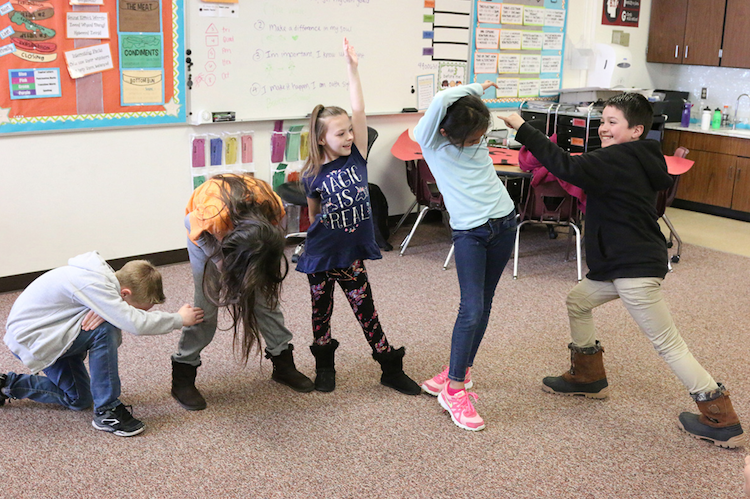
Children use movement to explore curricular concepts.
Charlotte Hawkins
Beverley Taylor Sorenson visual arts educator
I’ll never forget it. I was called into the principal’s office because I had offended a student. “Did you happen to say something to your student about Satan?” my principal asked me.
I knew exactly what he was talking about. I had asked my student to stop drawing demons, and start working on his animal drawing. Unfortunately, he was working on his animal drawing. Of a goat. (In my opinion, a sinister-looking goat with a human face.)
I could have avoided this whole messy situation if I’d asked the student this question,
“Talk to me about what you’re doing” — a simple metacognitive statement that you can use everyday to get your students in the habit of explaining their processes.
When students are given the opportunity to explain what they’re doing, they have a chance to review and clarify their plans. Students will often assess and make changes to their work just by talking through it with an adult. My student would have explained that goats have horns and four legs, providing evidence of said goat. I would have helped him to see that goats have muzzles, providing feedback to help him rework his drawing.
This question helps shift the invisible “metacognitive process, which is crucial to independent learning, and makes it overt, apparent and visible.” (Ron Ritchhart, Cultures of Thinking in Action)
You can ask variations too, like “What’s going on?” or, “What do you see that makes you say that?” Asking students “What makes you say that?” is a Project Zero thinking strategy specifically designed to get students thinking, explaining, and self critiquing. Project Zero, a Harvard Graduate School of Education initiative, creates simple, research-based strategies which enable students to engage and reflect for themselves.
Asking, “What makes you say that?” “cultivates observation, description, explanation building, and evidence-based reasoning.” (PZ-Harvard Graduate School of Education). Use this routine when you want students to look closely at something and uncover their reasoning about the way it works, how it came to be, or why it is the way it is.
- Ask students, “Talk to me about what you’re doing.”
- Ask students, “What makes you say that?”
- Ask students, “What’s going on?”
- Ask them for evidence to support what they’re thinking
- Document responses during class discussions to keep a list of explanations
- Model for students the type of thinking that you want them to develop by saying, “I’m saying this because…” or “Here is what I think is going on.”
Thinking strategies help teachers learn what and how their students think, and this strategy asks students to identify and provide evidence to support the why behind their thinking. Use this at the beginning of a lesson to access prior knowledge or to observe an artwork, artifact or musical performance and make hypotheses. Try asking your students about what they’re doing, before making your own assumptions (like me).
Subscribe to our Cultures of Thinking newsletter!
You'll get easy-to-apply thinking strategies delivered straight to your inbox every few weeks.


