Newsletter #9: Zoom In
Charlotte Hawkins
Beverley Taylor Sorenson visual arts educator
What Do You See?
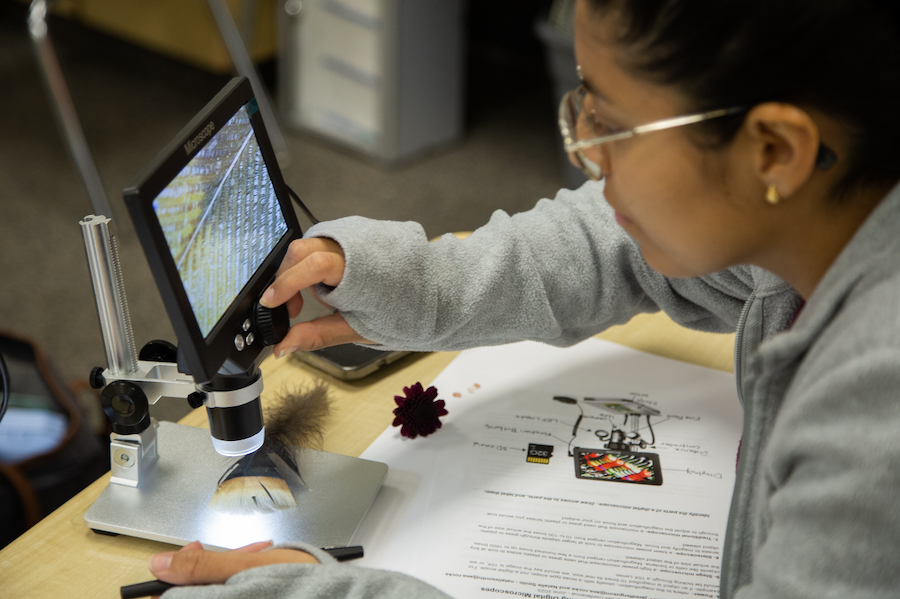
I’ve always been keen on cameras and photography. My father owned an old Nikon camera that documented much of my formative years. He’d take it apart and carefully clean it. It was during this time that I became aware of the inner workings of cameras and lenses. Lenses are fascinating tools. The ability to see an object from light years away via the Hubble telescope or, conversely, view an organism through a microscope fundamentally changes how we view the world. We can observe and notice the feathers of a bald eagle from a distance; then, a moment later, contemplate the tiny wings of a bee (thanks, bi-focal glasses!).
Technology gives us an opportunity to zoom in and out; to look; to notice and observe details about a subject while considering the whole. One thinking routine from Project Zero that can be helpful for observing and noticing is Zoom In. Project Zero, a Harvard Graduate School of Education initiative, creates simple, research-based thinking routines which can be used to look closely and make interpretations.
One Slice of Information at a Time
Zoom in limits the viewer to one small bit of information before zooming out to reveal more. The difference between this routine and the See-Think-Wonder routine is that Zoom In “reveals only portions of an image over time.” Ron Ritchhart suggests this idea: “that our interpretations…are limited by the information we have at hand is a metaphor about learning embedded in the routine itself.” He explains that we learn through minute observations before understanding the entirety (Ritchhart, Church & Morrison, Making Thinking Visible).
Using Storytelling to Illustrate Parts of the Whole
When considering what image, poem, movement pattern, or piece of music to present to your class, ask yourself, “Are there sections in this piece that tell different stories?” “Are the various parts as important and interesting as the whole?” Bear in mind that each part should add and build on the story.
- Set up. 3-5 minutes: Display or select a portion of a piece and ask learners to look or listen carefully. Allow time for observation. This can be done as a whole class or in small groups.
- Reveal. Zoom out to uncover more of the image or piece and ask for new information, interpretations, and hypotheses. What is new or different? Can the learners make predictions about what comes next or make connections to the whole?
- Repeat. Continue revealing. Zoom out again and again until the whole is revealed.
- Share the Thinking. Ask learners to identify ambiguous sections, important sections, and how seeing/hearing more shifted or changed their views.
The process of making small interpretations on limited information “enables learners to see that not only is it okay to change your mind about something, but in fact it is important to be open-minded and flexible enough to change your mind…” (Ritchhart, Church & Morrison, Making Thinking Visible).


