Tried and True Drama Games: One teacher’s favorite 10-minute acting games
This blog is one of a 3-part series. Be sure to also check out One teacher’s favorite 10-minute language & storytelling games and One teacher’s favorite 10-minute concentration games.
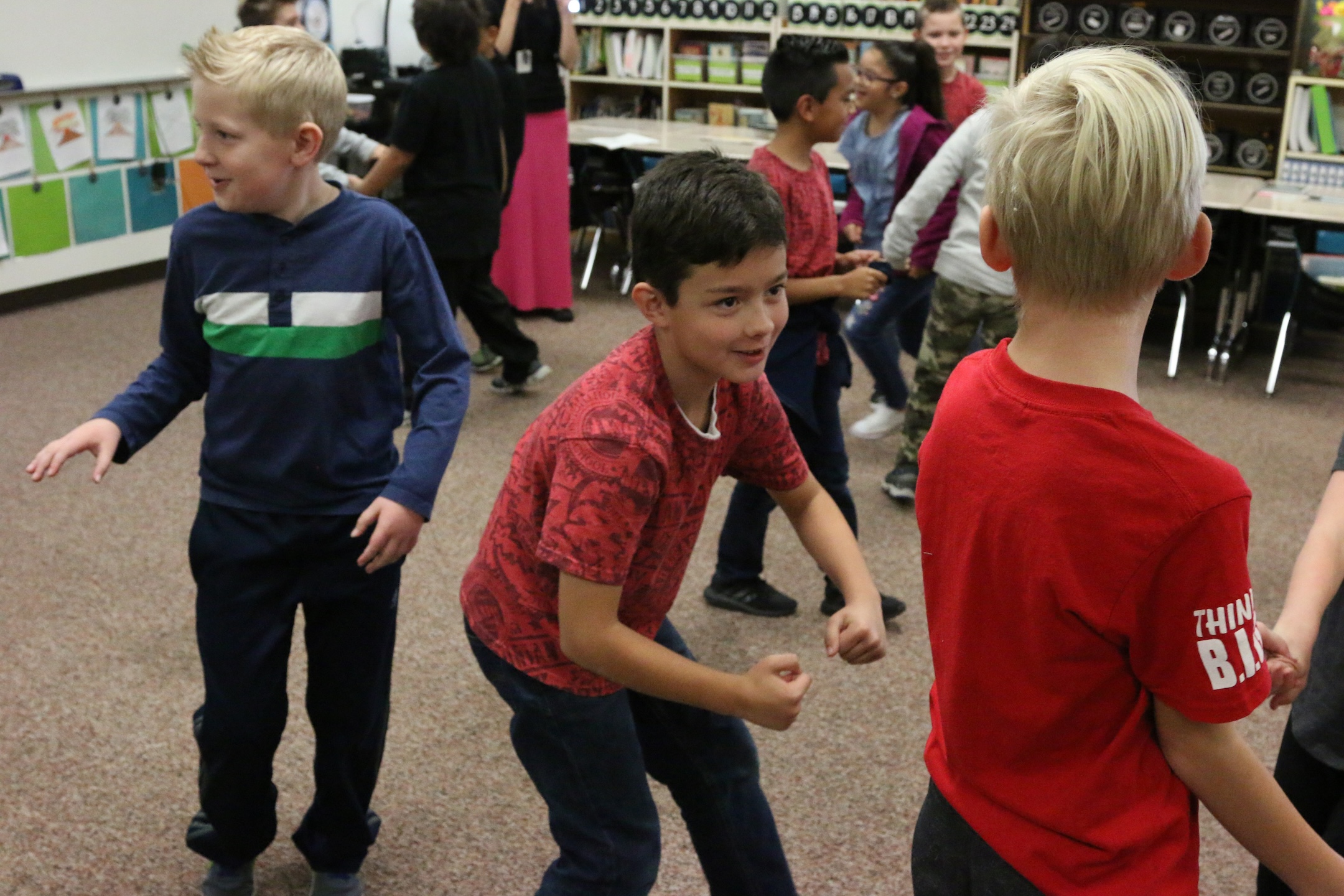
You’ve finished your lesson but there are 10 minutes until it’s time to transition. The class has finished cleaning up but there are a few minutes before the bell rings. With the assembly that’s happening today, your schedule is off by 15 minutes. What to do with this extra time? Play a drama game! I absolutely loved playing drama games in my classroom when I had 10-15 minutes to spare. You can also use them in morning meetings to build classroom community! The kids loved playing them and it built creativity, collaboration, and communication skills. Win-win!
Here are 7 of my favorite classroom drama games that incorporate acting and improvisation with a brief summary of each.
1. “This isn’t your ___, it’s my _____!”
Select a common object, such as a stapler or a scarf. Stand in a circle, holding the object and say “This isn’t a [selected object], this is my [select something entirely new]!” as you act out using that new object. For example, “This isn’t a scarf, this is my parachute!” as you jump using the scarf as a parachute. Then pass the object to the next student who would say “This isn’t your [newly imagined object - such as parachute], this is my [entirely new object]!” as they complete their action. Go around the circle until everyone has had a chance to imagine something new with the object. At the end, as it comes back to the teacher, state “This isn’t your [newly imagined object], it’s a [what the actual object is]!”
2. “Why are you late?”
Ask six players to take the stage. Choose four of the players to be “office workers”, one player to be the “boss”, and one player to be the “late worker”. The “office workers” should sit facing the audience, miming typing on a computer. The “boss” and “late worker” leave the room while the “office workers” come up with a reason why the “late worker” is late. (i.e. Her hair got caught in the hairdryer!, Her car got crushed by a dinosaur!, etc.) Once the “office workers” have decided, they go back to typing at their computers. The “boss” enters and stands with his back to the “office workers” so he can’t see them. Then the “late worker” enters and faces the boss. The “late worker” can see the “office workers,” but the “boss” can’t. The “boss” asks the “late worker,” “So, why are you late?!” The “office workers” mime out the reason for lateness behind the “boss'” back and the “late worker” has to guess what it is. At any time, the “boss” can turn around to face the “office workers” – if he catches one of them not typing, that “office worker” is fired and must leave the office. The game ends when the “late worker” guesses the correct reason for lateness, or the “boss” fires all the “office workers.”
3. Space Walk
Students walk around the room, investigating the space. Encourage them to really feel the space with every part of their body - their back, their neck, their eyes, their arms, etc. Next, the students imagine they are walking through a different kind of space, such as a humid jungle. What do they feel as they walk through the space this time? How might their gait or walk change depending on the environment? What obstacles might they face in this space as they walk through it? Try other spaces such as wading through a river, crossing the desert, walking on the moon, or sludging through honey!
4. Trapped
Select a student to be the player. The player chooses an environment from which they are trying to escape, such as a car trunk, a bear trap, an elevator, etc. They act as if they are in that environment and are trying to escape it. The rest of the class can guess the environment where they are trapped. For an additional challenge, require the players to pantomime, making no noise.
5. “Yes, Let’s!”
Before playing, let the group know that whenever a suggestion is made, the group will enthusiastically respond in unison, “Yes, let’s!” Begin the game by making a suggestion with the following phrasing: “Let’s all be…”. Follow this phrase with a suggestion of almost anything, such as tigers, clouds, cars, chainsaws, fish, clowns, etc. After the group has exclaimed, “Yes, let’s!” and performed your suggestion for 20 or 30 seconds, allow another student to make a new suggestion. This can be done in a circle with each student taking a turn, or more randomly in free space around the room.
6. “How old am I?”
Ask any number of students (3-5 works well) to be the players. They will approach an imaginary bus stop and wait for the bus acting as a certain age (80 years old, 2 years old, 15 years old, etc.). The audience, after some time, can guess which ages are being displayed. Discuss why they guessed that age (evidence they saw) and how close they were to what the player was trying to portray. Note: You can side-coach by saying things like “The bus is late. How do you feel about that?”, “It’s only a block away now. It’s getting closer!”, or “Oh, it’s caught in traffic and now your ride is cancelled!” to encourage different expressions from the players.
7. Gibberish
This game can be played in a variety of ways, but should always start with the whole class practicing gibberish. Have them turn and talk to their neighbors in an unknown language but conversing as if they were making perfect sense. Whether played in pairs, small groups, or one student in front of the class, have the students use gibberish and their body language to explain something to see if others can guess what it is they are talking about. It might be that they are selling a product and their partner has to guess what it is they are selling, or they are telling a police officer of a crime they just witnessed. Get creative or present a challenge that ties into the curriculum they are learning about!
Several of these games were taken from 101 Games that Teach Storytelling Skills by Anthony & Mike Burcher, Theater Game File by Viola Spolin, Beat by Beat Press, and the Drama Notebook website. Check them out to learn even more fun drama games and activities for your classroom! And visit our website to learn more about using drama in the classroom.


