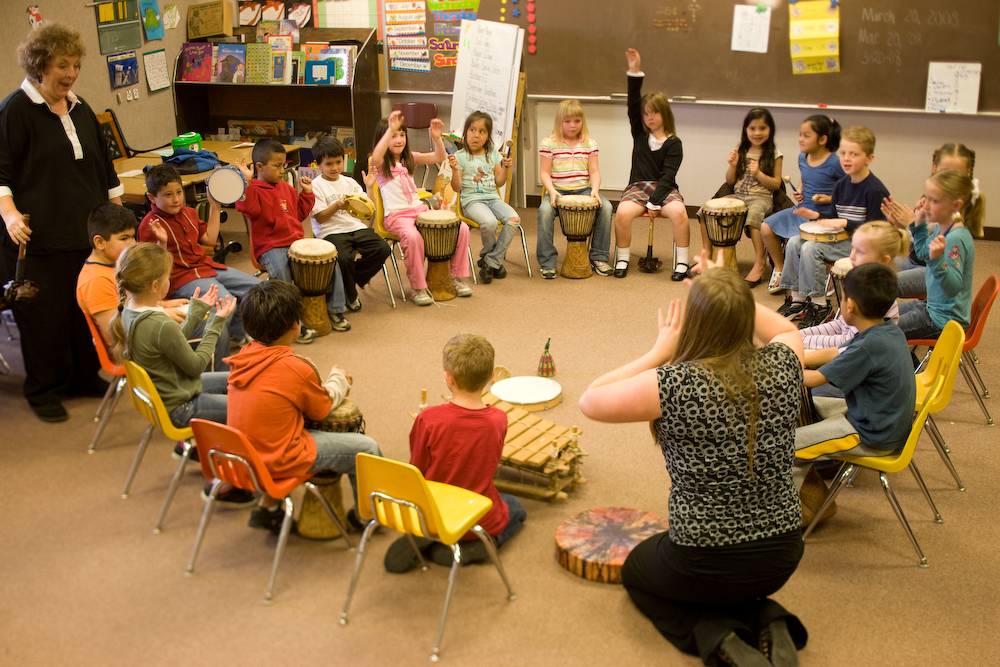
Well-being, Literacy, and Streamlining Instruction: Our Priorities in Professional Development for Teachers
The Mission of the BYU ARTS Partnership
The mission of the BYU ARTS Partnership is to ensure that all children benefit from an education that provides academic excellence, social confidence, and personal expression through experience with the arts. The greatest impact for change will be accomplished through collaborative efforts involving teachers, parents, schools, districts, departments, and universities.
In 2005, we began creating and implementing professional development for elementary teachers to include the arts in their classrooms every day. Our programs appealed to elementary teachers because the arts bring joy to the classroom.
However, it was critical that we not add expectations to their classrooms, already burdened with high-stakes testing and expectations to teach 11 curricular areas. We sought strategies for these non-artists to use the arts to improve areas of critical need in their classrooms. Three areas of focus were prioritized to meet the immediate needs of teachers and students.
- Improve the well-being of teachers and students.
- Improve literacy skills across the curriculum.
- Align pedagogies and frameworks across the curriculum to streamline instruction.
These priorities remain foundational to the vision for arts-integrated instruction in the BYU ARTS Partnership. Additionally, current feedback from our teachers indicates these are still relevant. A closer look at each of these priorities follows.
1. Improve the Well-being of Teachers and Students
We seek to support teachers with experiences in the arts that help them develop a sense of autonomy and strengthen creative agency. When teachers find their voice as a person, an artist, and an educator they increase their resilience and ignite their passion for teaching and learning. Teaching is a demanding and stressful profession. Whether new to the field or seasoned with decades of experience, no teacher is immune to stressful and high-stakes situations.
The ideas and strategies listed in this book were designed not only to support learning in each art form but to help teachers and students feel relaxed and grounded while learning. Nurturing well-being for teachers and students supports the development of quality relationships, which are at the heart of learning and school culture.
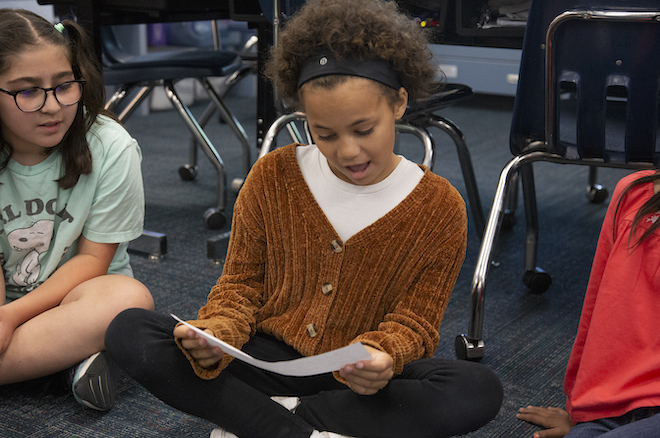
The arts offer embodied experiences that are multi-sensory and engage the physical, mental, emotional, and social aspects of living and learning. These experiences help students focus and relax, improving performance and relationships. In this book, learn strategies for leading choral singing, sketching in notebooks, writing poems, and releasing tension in the body while performing a brain dance, and more.
2. Improve Literacy Skills Across the Curriculum
Since reading, writing, and communication are central to learning in all disciplines, we prioritized arts skills and activities that reinforce literacy skills. Teachers consistently need support with reading and writing.
Strategies from the disciplines of dance, drama, literary arts, media arts, music and visual arts. We focus on literacy in regards to being able to read and write with the English language, as well as literacy in each art form, using dances, songs, theatrical performances, and visual arts as text. We believe learning to create, communicate, and interpret both the English language and the language of the arts are essential experiences for students.
3. Align Pedagogies and Frameworks Across the Curriculum to Streamline Instruction
How can teachers meet the many demands put on schools today? There are often 11 areas of required curriculum for an elementary teacher to cover. We knew when we designed our programs and curriculum that we could not add one more expectation to a teacher's plate, so we worked to prioritize and simplify instruction.
We found pedagogies from the field of arts education that worked for all art forms and then found they worked across all content disciplines as well (e.g. the Studio Structures for Learning and Habits of Mind, problem-based learning, Nexus Teaching, etc.). Modeling and showing how the arts can be integrated to serve multiple learning objectives at a time is part of our mission to reduce the load and stress on teachers in classrooms today. Identifying cross-cutting pedagogies simplifies teaching across multiple curricular areas by applying various learning strategies simultaneously that address the varied needs of students.
Changing the Climate of Education
With our new text book and our programs, we hope to change the climate of education to support experiences where the arts are used to improve well-being, increase literacy, and reduce the stress of teachers, students, the school, and the community. We weave these three goals together to improve daily life and learning in classrooms. Because the challenges in society are reflected in schools, our schools are asked to compensate for poverty, learning challenges, mental health issues, and more. The job of being a teacher requires diverse skills that involve an excellent understanding of people, society, and multiple content areas. By applying concepts in the arts in the classroom, teachers can provide students with the relationships, content, and engaging pedagogies they need for a fulfilling schooling experience.