What My Students (and I) Learned from a BYU Arts Bridge Scholar
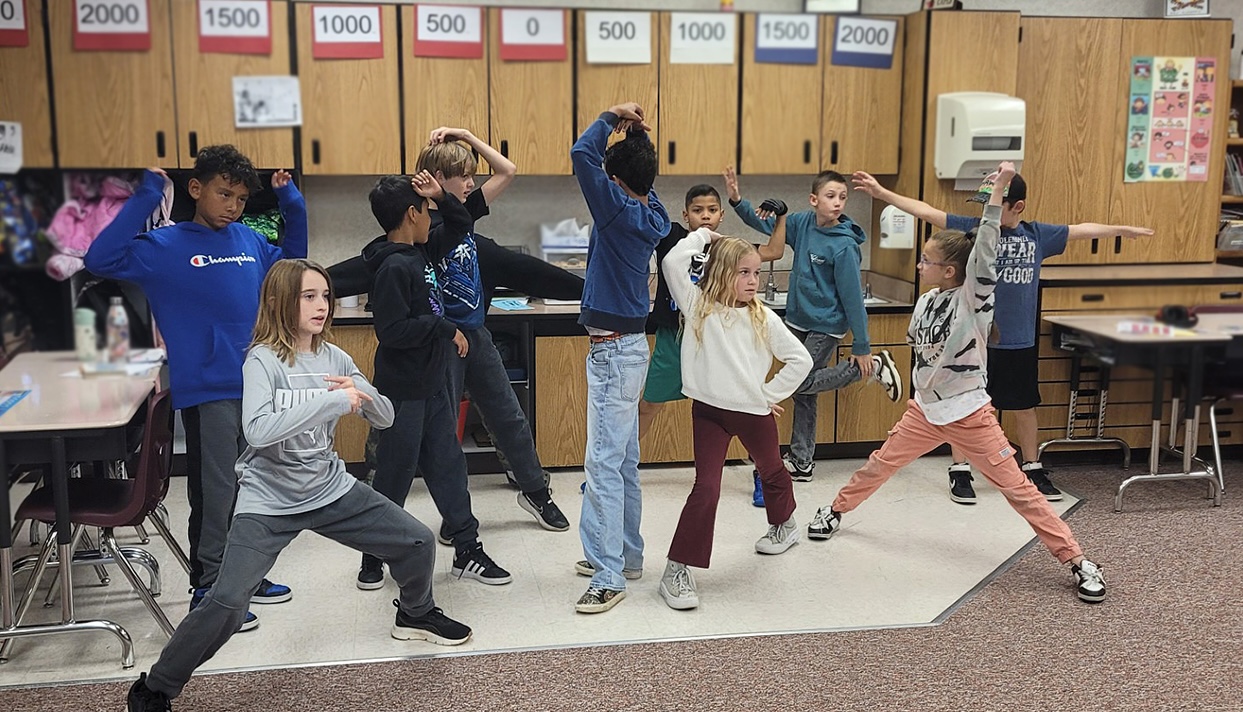
What can a group of first grade students and an experienced classroom teacher learn from a university arts student? As it turns out – a lot! My class recently had the privilege of hosting a BYU dance student for a semester. Everything about this experience was positive. It was a time of learning, fun, and connecting. There were too many benefits to write about here, but these are a few of them.
Integration
Camila, our dance scholar, integrated movement and dance with curriculum that we were currently learning. This is beneficial to all students, especially those who learn best kinesthetically.
While learning about the sun, moon, and stars, the children moved safely though the space while learning the difference between rotating and orbiting. They used movement to represent their learning about which color of stars are the hottest or coldest. The students used dance and shapes of movement to represent addition and subtraction math problems; they even learned specific movements to help them distinguish between the addition and subtraction symbols. Camila read books and the children danced through elements of story.
These are just a few short examples of the many ways dance and music were integrated with science, math, and literature, enhancing my students’ cognitive development by giving them opportunities for problem-solving, using their memories and expressing themselves creatively.
Elements of Dance
Many young children will never have the opportunity to participate in formal dance lessons. Many have never seen live dance performances. Through our experiences with our dance scholar, the children were able to do both. As they moved and danced, they were able to explore elements of dance including body, action, space, time, and energy.
One benefit of dance includes improving physical coordination. We know this can also improve children’s academic skills, such as reading. Social skills are improved as they work together with other students. Motor skills are improved as they move, freeze, change rhythm, improve strength, and learn that they can use their bodies in ways they never have before.
Joy and Confidence
While dancing, I witnessed laughter and joy. Rather than sitting at a desk, filling out a worksheet about science or math, the children learned to dance while they learned core standards. Rather than writing words about their learning, they were coming up with ways to express this knowledge physically.
Every child felt successful. Yes, there was some initial trepidation as this was a new experience for many of them. I noticed that some of the students had difficulty skipping at first, something many of us think is so simple. But, as the sessions continued, I saw their confidence grow. They all got out there and tried. They smiled. They laughed. They danced and they learned.
Laura Giles is a lover of all things art. She is a first-grade teacher in Alpine School District, a writer for The Daily Herald newspaper, an Arts Leadership Academy graduate, and has earned the Arts Integration Endorsement from Brigham Young University. She can be reached at LauraCGiles@gmail.com


